Quick Answer
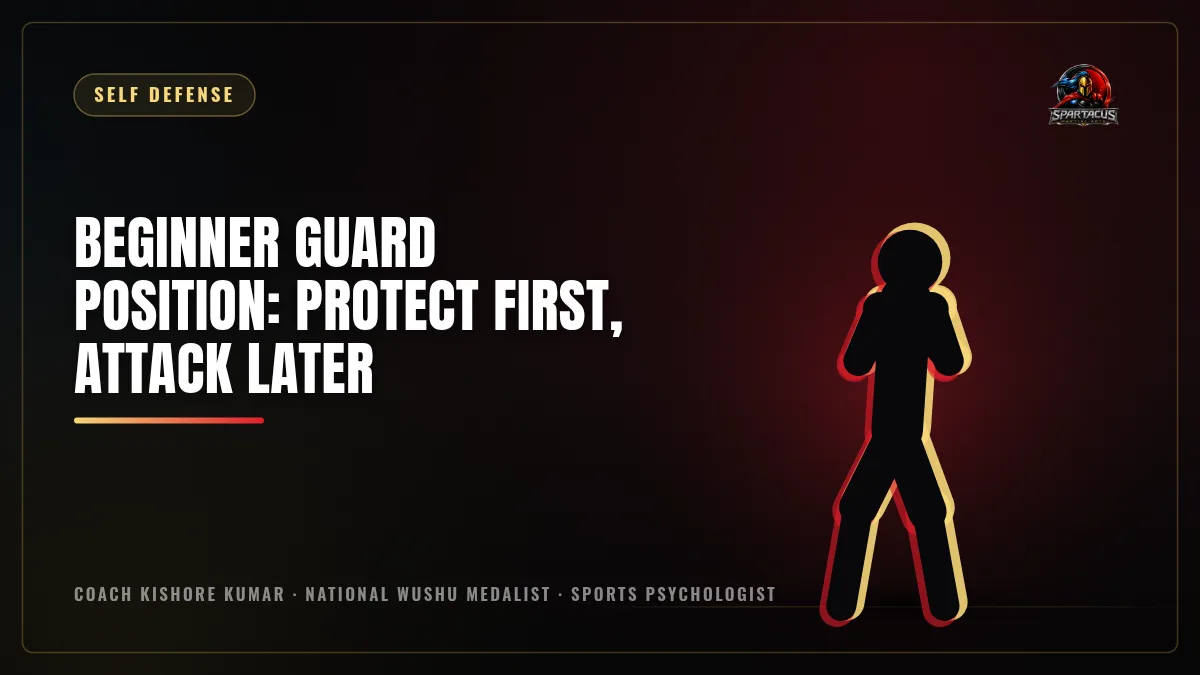
The guard — hands up, chin down, elbows in, knees soft — is a beginner's first and most important skill. Protection makes everything else possible; attack without defense is gambling.
Watch beginners shadowbox: impressive punches, with hands drifting to the waist between them. In their imagination, only they are attacking. The guard is where that fantasy is replaced with skill.
The guard, piece by piece
- Hands — at cheekbone height, lead hand slightly forward, rear hand near the chin. Always returning home.
- Chin — tucked, looking through the eyebrows.
- Elbows — close to the ribs, protecting the body.
- Shoulders — relaxed, slightly raised to protect the jaw.
- Knees — soft, ready to move in any direction.
- Feet — about shoulder-width, one foot forward, weight balanced.
Why defence comes first
Every attack you throw opens a gap in your defence. Knowing your guard is one motion away lets you attack with commitment instead of anxiety. Defence is not the opposite of attack — it is what makes attack affordable.
Training the return
The real skill is not holding the guard — it is returning to it, automatically, after every technique, especially when tired. We drill the return until your hands come home without being called.
- Punch-and-touch — after each punch, touch your cheekbone before the next.
- Partner taps — a partner lightly taps an open target if your hands drop.
- Mirror work — watch for drifting hands during shadowboxing.
- End-of-round checks — practise keeping the guard when most tired.
Common guard mistakes
- Hands drifting down when tired
- Elbows flaring out, exposing the ribs
- Chin up, eyes wide
- Tense shoulders — tiring quickly
- Standing square, presenting a bigger target
Why do my arms tire holding the guard?
Usually because of tension. Holding your arms rigidly burns energy fast. The guard should be relaxed but ready — muscles loose, hands in position. Shoulder endurance also improves with training. Read why softness can defeat tension.
Is the guard the same in all striking arts?
The principles are the same — protect the head and body, stay balanced — but details vary. Boxing guards are tight and high. Kickboxing guards allow for kicks and checking. Karate stances may hold the hands differently. Wushu Sanda adds protection against throws. Your coach will teach the guard for your art.
How long until the guard is automatic?
With regular practice, most beginners keep a reasonable guard within a few weeks during simple drills. Keeping it when tired or under pressure takes months. It is a skill you refine for as long as you train.
The guard in self-defence
In self-defence, a trained guard reflex — hands coming up to protect the head — can protect you in the chaotic first second, when thinking is too slow. A raised "fence" with open hands also helps keep distance and signals calmly that you want space. Read why self-defence starts before the fight.
Related basics
Read beginner punching mistakes and why footwork is the secret weapon.
Build it early, keep it forever. Train with Coach Kishore: book a free trial class at Spartacus.