
Quick Answer
The Warrior Mind Method is Spartacus Martial Arts Academy's five-pillar mental training framework: Focus (attention control), Fire (motivation and intensity), Flow (performing without over-thinking), Forge (recovery and resilience) and Fight (competing under pressure). Each pillar is trained deliberately, the same way a technique is drilled.
Every athlete I have ever coached has had a mental training programme. Most of them just did not know it, because it was accidental, invisible and built out of whatever happened to work last season.
The Warrior Mind Method makes it deliberate. Five pillars — Focus, Fire, Flow, Forge, Fight — each one a trainable skill with its own drills, its own failure symptoms and its own fix. This is the framework I use at Spartacus Martial Arts Academy with martial artists, school athletes and competitors from other sports.
Why does mental training need a framework at all?
Because "be more confident" is not an instruction. It is a wish. Athletes improve when the mental side is broken into components small enough to practise on a Tuesday, exactly like footwork.
The five pillars also give you a diagnosis. When a performance goes wrong, you can usually name which pillar failed — and that turns a vague bad day into a specific piece of homework.
Pillar 1 — Focus: where is your attention actually pointing?
Focus is attention control: choosing what to pay attention to, noticing when you have drifted, and returning without drama. Most competition errors are attention errors — watching the scoreboard instead of the opponent, or replaying the last mistake while the next attack arrives.
How to train it: single-task drills with a named cue ("watch the shoulder"), pad rounds where you call the target before it is thrown, and the 5-second reset drill for returning after a mistake. Children benefit enormously here too — see can martial arts improve focus in school students.
Failure symptom: you remember the crowd, the lights and the score better than you remember your own techniques.
Pillar 2 — Fire: is your intensity chosen or accidental?
Fire is your energy system — motivation, drive and arousal level. Too little and you are flat and slow to react. Too much and you are tight, rushed and exhausted by round two. Neither is a personality trait; both are adjustable.
How to train it: learn your own ideal intensity by rating it 1–10 after good and bad performances, then build a pre-performance routine that moves you toward that number — breathing to come down, sharp movement and self-talk to go up.
Failure symptom: brilliant in training, flat or frantic in competition.
Pillar 3 — Flow: can you perform without commentary?
Flow is execution without interference — trusting trained movement instead of narrating it. You cannot force flow, but you can remove what blocks it: over-instruction, perfectionism, and thinking about outcomes mid-performance.
How to train it: practise with external cues rather than internal ones (aim at the pad, not at your elbow angle), use one simple performance cue per round, and deliberately train at competition speed so the pace is familiar.
Failure symptom: you are thinking in full sentences during a bout.
Pillar 4 — Forge: what do you do with damage?
Forge is resilience and recovery — how you handle losses, injuries, plateaus and bad weeks. This is where most careers quietly end, not in the final. An athlete who cannot metabolise a defeat will avoid the situations that cause defeats, which means avoiding growth.
How to train it: a fixed post-performance review (what worked, what to fix, one action), a training journal, real rest days, and the practice of losing gracefully as a skill rather than a mood.
Failure symptom: one bad result costs you three bad weeks.
Pillar 5 — Fight: can you deliver when it counts?
Fight is competitive courage — the willingness to commit fully when the outcome is uncertain and public. It is the pillar people assume is innate. It is not; it is built through graded exposure to pressure.
How to train it: add stakes gradually — a watching partner, then a small audience, then a scored round, then a real event. Prepare with a proper pre-competition confidence routine rather than hoping to feel brave on the day.
Failure symptom: you hesitate at the moment of commitment and finish thinking "I had that".
How do the five pillars work together?
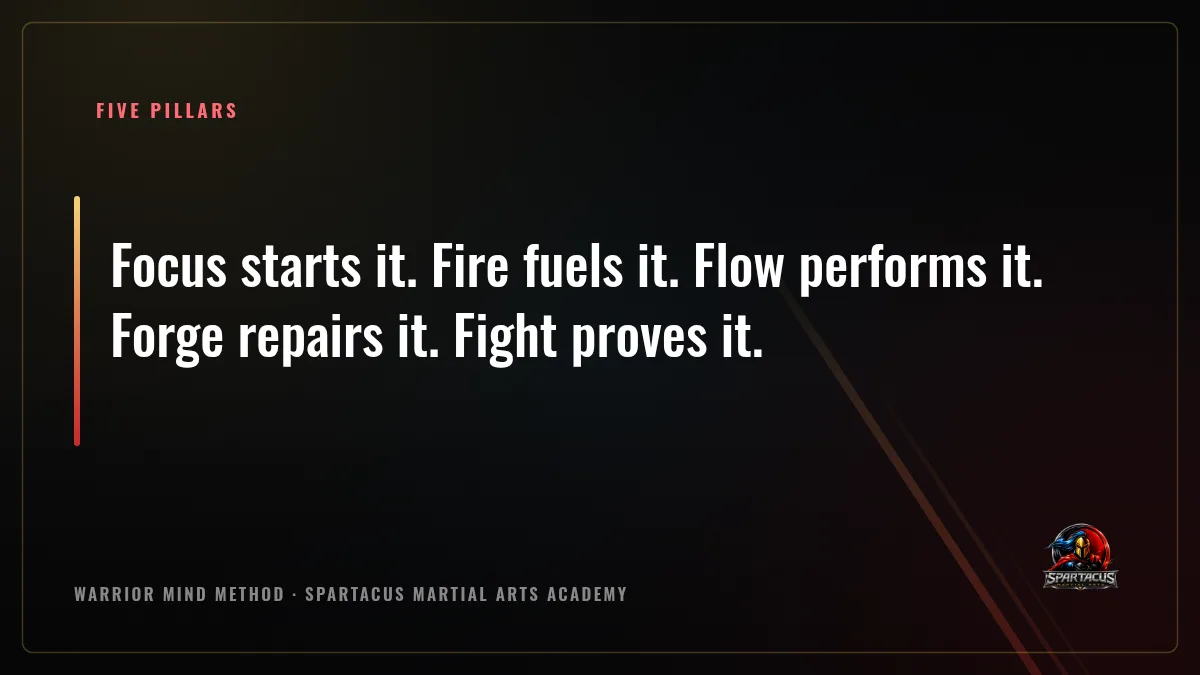
In sequence, and honestly quite simply: Focus starts it. Fire fuels it. Flow performs it. Forge repairs it. Fight proves it.
A weak pillar drags the others down. An athlete with excellent Fire and no Focus burns energy in the wrong direction. An athlete with great Flow and no Forge looks unbeatable until the first real loss.
How do you find your weakest pillar?
Score yourself out of 10 on each after your next three sessions or competitions. The lowest score is your training priority for the next eight weeks — not your favourite pillar, which is usually the one you are already good at.
Want this coached properly? Mindset sessions at Spartacus run alongside martial arts classes in Chennai and are also available online for athletes outside Chennai. book a free trial class or message Coach Kishore on WhatsApp.