Quick Answer
Wushu pairs every flexibility gain with strength at that new range — high kicks need loose hamstrings AND strong hips. Training both together builds ranges you can actually use.
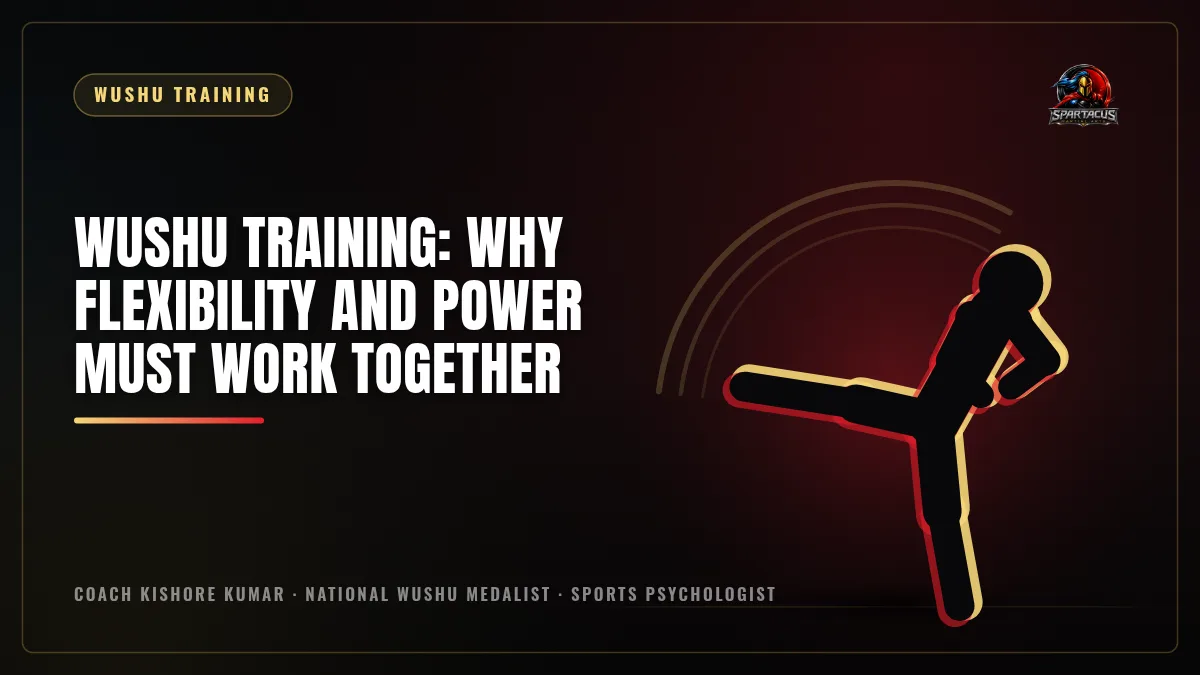
People watch a Wushu high kick and say, "So flexible!" They are half right. What they are really seeing is strength standing inside flexibility — and in Wushu, one without the other is useless.
Two kinds of flexibility
It helps to separate two ideas:
- Passive flexibility — how far a joint can move when something else pushes it there: gravity, a partner, your hands.
- Active flexibility — how far you can move a joint using your own muscles, and control it there.
A split on the floor shows passive flexibility. A slow, controlled kick held at head height shows active flexibility. Wushu needs both, but active flexibility — strength at range — is what makes techniques usable.
The floppy trap
A student who only stretches gains range they cannot control: legs that reach high but wobble, split positions with no power. It looks good in photos but fails in movement. Uncontrolled range can also be a risk, because the joint is unprotected at its limits.
The stiff trap
A student who only strengthens builds power inside a shrinking cage. Kicks stay low, stances stay shallow, and injury risk climbs when movements suddenly reach the edge of their range.
How Wushu trains both together
- Dynamic kicks — straight-leg kicks, crescent kicks and swings build flexibility with momentum control.
- Low stances held for time — horse stance, bow stance and drop stance build strength at deep ranges of the hips and legs.
- Slow leg raises and holds — lifting and holding the leg high without momentum builds active flexibility.
- Stretching after training — longer static stretches when the body is warm, to gradually increase passive range.
- Explosive jumps and kicks — once range and control are established, power is trained through that range.
Read why stretching alone is not flexibility training for the principles behind this approach.
A sample progression for a stiff beginner
- First weeks — dynamic leg swings, gentle stretching after class, shallow stances held briefly.
- Next couple of months — straight-leg kicks with good posture, deeper stances held longer, slow leg raises.
- After that — higher kicks with control, drop stances, introduction of jumps.
Everyone progresses at a different rate. Age, previous activity and consistency all matter.
I am very stiff. Can I still learn Wushu?
Yes. Flexibility is something Wushu builds, not something it requires. Many students start unable to touch their toes. What matters is consistent, sensible training — and patience.
How long until I can kick high?
It varies widely. Children often progress quickly; adults usually need longer. With regular training several times a week, most students notice clear improvement within a few months. High, controlled kicks may take a year or more for adult beginners — and that is normal.
Is deep stretching dangerous?
Forced, bouncing or painful stretching is. Stretching should feel like strong tension, never sharp pain, and should be done on warm muscles. Never let anyone force you into a split. Read how to train martial arts safely.
Why this matters beyond Wushu
Strength through a full range of motion protects joints, improves posture and helps in every sport. It is also why Wushu develops such well-rounded athletes. Read how Wushu builds athletic coordination and why precision matters in Wushu forms.
Patience required, results delivered
Usable flexibility builds over months of paired training. With consistent practice, the body adapts at any starting point. See how we train it with Coach Kishore, a National Wushu Medalist — read our Wushu beginner guide or book a free trial class.