Quick Answer
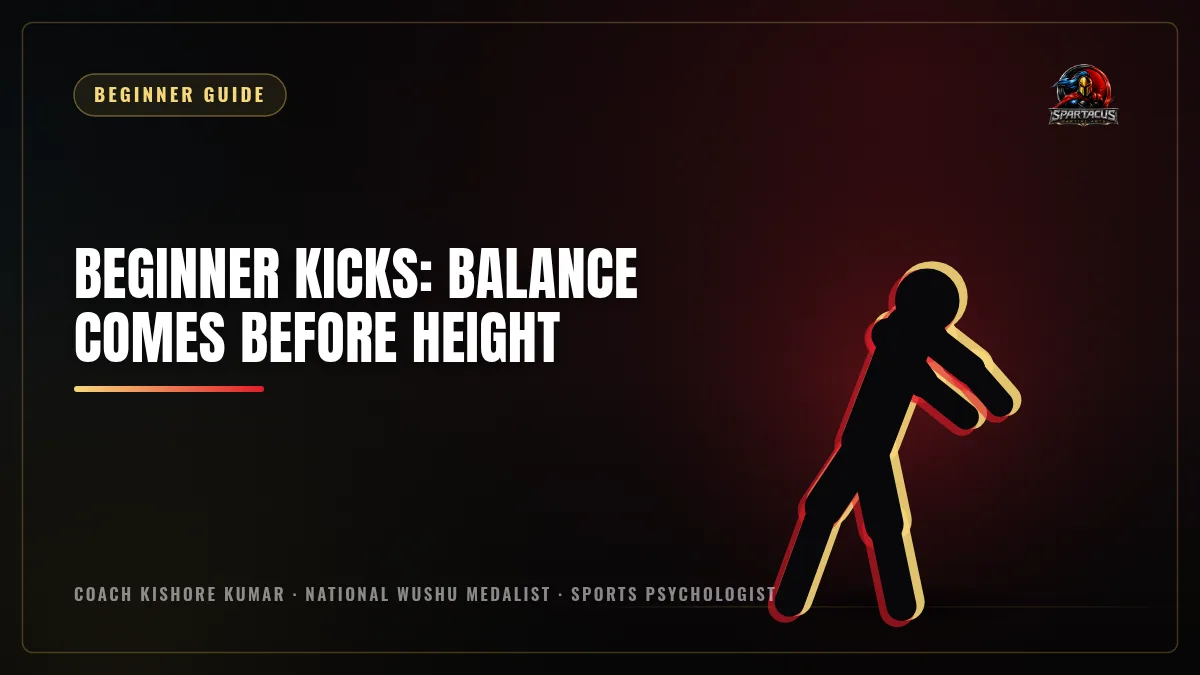
A kick is only as good as the leg you are standing on. Train balance, chamber and control at low heights first — height arrives naturally once the base is solid.
Every new batch includes students who want movie kicks within a month. I show them an unglamorous truth: the standing leg is the kick.
The falling kick problem
A high kick with a wobbling base is really just controlled falling. It has no power, no recovery and no second technique behind it. In self-defence, it leaves you off-balance and vulnerable. Height without balance is a photograph, not a skill.
Build from the floor up
- Base foot — planted, often turned slightly outward for turning kicks, weight settled, knee soft. Never kick with a locked standing knee.
- Chamber — lift the knee up and tight before extending. The chamber hides your intention and loads the kick.
- Extension — controlled, with a sharp exhale on delivery. Strike with the correct part of the foot for that kick.
- Re-chamber — pull the leg back to the chamber before placing it down. The kick returns; you never fall out of it.
- Return to stance — guard up, balanced, ready for the next technique.
The first kicks beginners learn
- Front kick — straight forward, striking with the ball of the foot.
- Roundhouse kick — circular, striking with the instep or shin, turning on the base foot.
- Side kick — sideways thrust with the heel or edge of the foot.
Each follows the same base–chamber–extend–re-chamber pattern.
The knee-height phase
Beginners at Spartacus kick low targets until the full sequence is smooth on both sides. It feels humble. Then one day the same mechanics rise — and the kick that arrives at a higher target is strong, balanced and repeatable.
Balance drills you can do at home
- Single-leg stand — 30 seconds each side, then try with eyes closed.
- Chamber holds — lift into the kick chamber and hold for 10 seconds without wobbling.
- Slow kicks — extend and re-chamber a kick over five seconds.
- Wall kicks — hold a wall lightly for balance and practise the full sequence slowly.
Why does my kick feel weak?
Usually because the power is coming from the leg alone. Strong kicks use the hips — turning the base foot, rotating the hips and driving through. Weak core and a wobbling standing leg also leak power. Read the secret of strong kicks: hips, balance and timing.
How long until I can kick head height?
It depends on your age, starting flexibility and how often you train. Children and teens often get there within months. Adult beginners may take a year or more — and some kick perfectly well at body height for their whole training life. Flexibility work alongside kicking practice speeds things up. Read why flexibility and power must work together.
Are high kicks even practical?
For self-defence, low and middle kicks to the legs and body are generally more practical — they are faster, safer and keep you balanced. High kicks are valuable for flexibility, athleticism and competition, and training them improves all your kicks. In Wushu and sport forms, high kicks are part of the art.
Safety tips
- Always warm up before kicking. See why warm-ups matter.
- Never force height with momentum alone.
- Kick into the air with control — do not snap the knee straight.
- Stop if you feel sharp pain in the knee, hip or back.
Chase control, and height will follow. Start the right way with Coach Kishore: book a free trial class.