Quick Answer
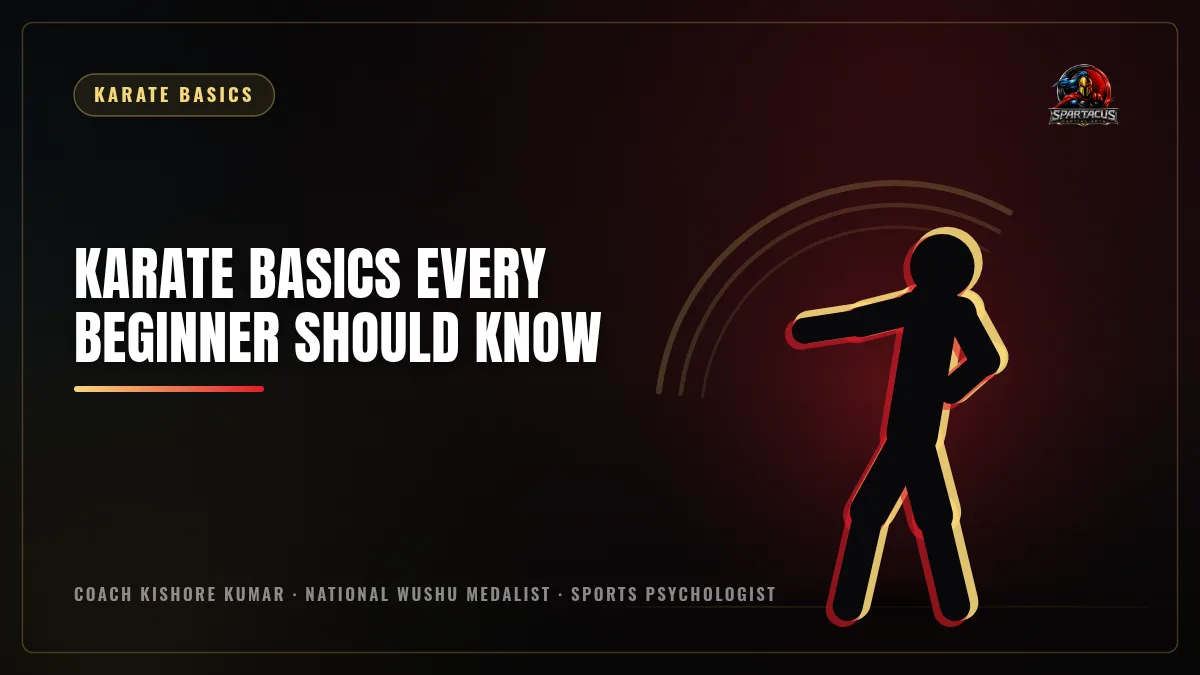
Every Karate journey starts with four things: a stable stance, the straight punch, basic blocks, and dojo etiquette. Master these under proper coaching and every later technique builds on them.
New year, new Karate students. Before anyone dreams of board breaks and flying kicks, let me show you the foundations every beginner actually needs. Master these properly and every later technique builds on them; skip them and you will be fixing the same problems for years.
1. Stance before strikes
Power comes from the ground. A stable stance is the platform everything else stands on. Beginners usually learn three stances first:
- Front stance (zenkutsu-dachi) — long and deep, front knee bent over the foot, back leg strong. Used for powerful forward techniques.
- Back stance (kokutsu-dachi) — most of the weight on the back leg, used for defence and quick movement.
- Horse stance (kiba-dachi) — feet wide, knees bent outward, like sitting on a horse. Builds leg strength and a low centre of gravity.
Common errors: knees collapsing inward, heels lifting, leaning the upper body. We drill stances until they feel like home.
2. The straight punch
The straight punch (choku-zuki, or oi-zuki when stepping) is the foundation of Karate striking. The key points:
- Start with the fist chambered at the hip, palm up.
- Drive it straight towards the target, rotating the fist so the palm faces down at the end.
- Pull the other hand back to the hip at the same time — this "pull hand" adds power and balance.
- Hit with the first two knuckles, wrist straight.
- Snap back or hold briefly with control, depending on the drill.
One punch, practised a thousand times, beats a hundred techniques practised ten times.
3. Blocks that become reflexes
The three basic blocks are the rising block (age-uke), protecting the head; the inside or outside middle block (uchi-uke/soto-uke), protecting the body; and the downward block (gedan-barai), protecting the lower body. Practise them slowly at first, then rhythmically, then automatically. Blocks are your insurance policy — pay the premium in repetitions.
4. The front kick
The front kick (mae-geri) is usually the first kick taught. Lift the knee high, extend the lower leg, strike with the ball of the foot (toes pulled back), and retract the leg before placing it down. Balance comes before height — see beginner kicks: balance before height.
5. Etiquette is technique too
Bowing when entering the training area, bowing to your partner, listening, and waiting your turn — dojo etiquette trains the same discipline that makes your techniques sharp. Skip the manners, and the skills stay shallow. Read the real meaning of the martial arts bow.
6. Your first kata
Kata are set sequences of techniques performed solo. The first beginner kata combine basic stances, punches and blocks in a simple pattern. They teach memory, rhythm, balance and how techniques connect. Do not rush through them — precision matters more than speed. Read why slow practice builds fast reactions.
A simple home practice routine
- Hold each stance for 30 seconds, checking your knees and feet.
- 20 slow straight punches with each hand.
- 10 of each basic block on each side.
- 10 slow front kicks per leg, holding the chamber position for balance.
- Walk through your kata once slowly, then once at normal speed.
Ten to fifteen minutes is enough. Consistency matters more than duration.
How long does it take to learn the basics?
Most beginners can perform basic stances, punches, blocks and a front kick with reasonable form within the first couple of months. Making them sharp and automatic takes longer — that refinement continues for as long as you train.
Do you need equipment to start?
No. Comfortable sports clothing is enough for the first classes. A Karate uniform (gi) and belt follow once you continue, and protective gear comes later when partner work increases.
For a full introduction, read our beginner's guide to Karate training in Chennai. Begin your Karate journey properly — book a free trial class at Spartacus or see our martial arts classes in Chennai.